
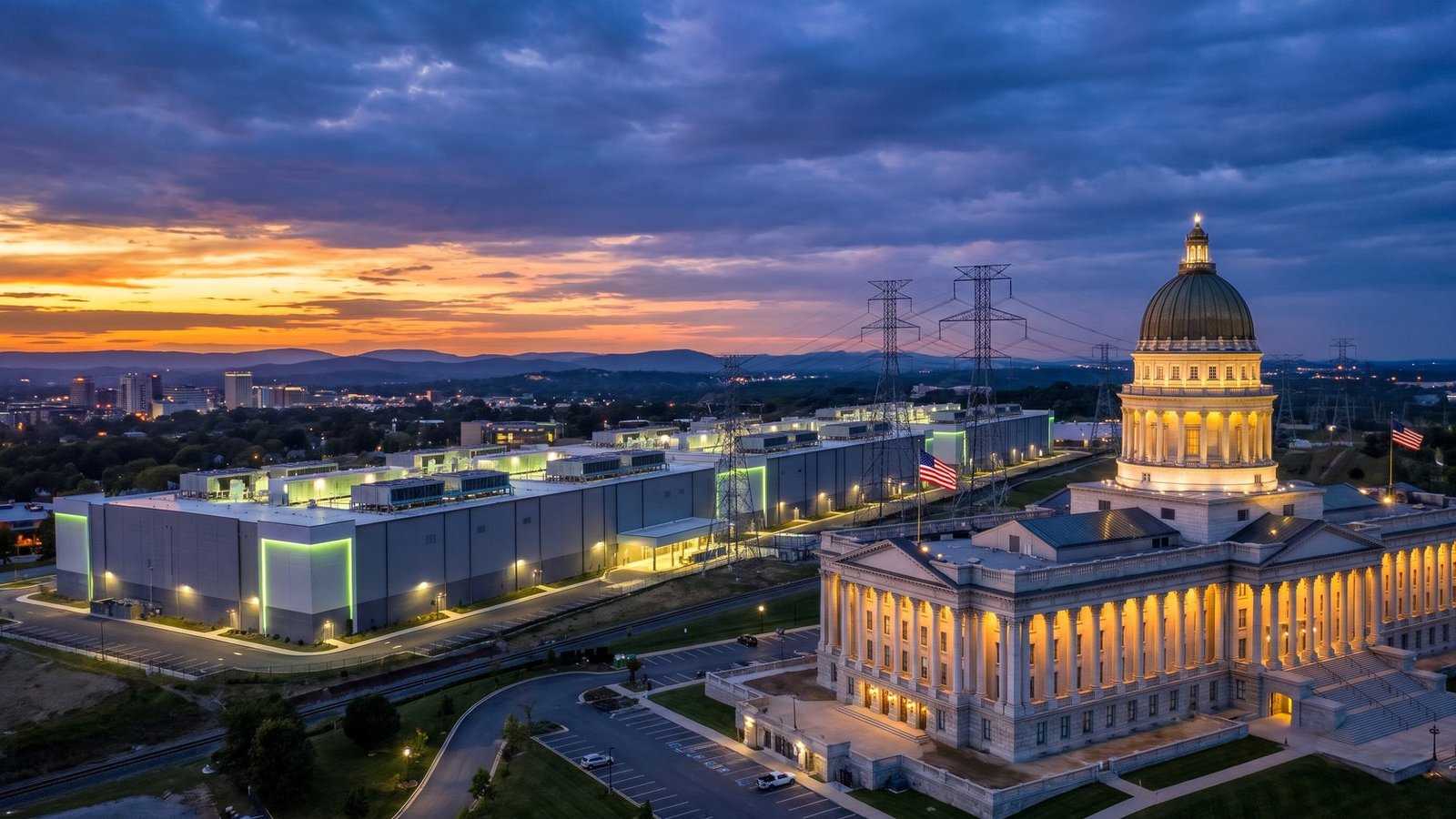
For the past few weeks I've written about data center fights one state at a time: Ohio's local revolt, then North Carolina's battle over who pays for new power plants.
Last Tuesday, those fights went national.
Voters didn't just pick candidates. In dozens of communities they voted on data centers directly, and they said no almost everywhere. At the state level, new governors and legislatures that campaigned on slowing data center growth are taking office in some of the country's most important markets.
The question for anyone building, financing or powering AI infrastructure is no longer whether the rules will change. It's how fast, where, and what a project needs to look like to get built anyway.
What actually changed
According to the Associated Press, Democrats picked up governorships in Georgia, Iowa, Ohio and Texas, and will hold at least 28 governorships in 2027. They flipped the Texas House for the first time since Republicans took it after the 2002 election, flipped both chambers in Wisconsin, and gained full control of state government in at least five states. They also broke or prevented Republican supermajorities in nine legislative chambers across eight states. The National Conference of State Legislatures called it the biggest single-election shift in state government power since 2010.
Three of the new governors ran directly on data centers, according to Fortune:
| State | Governor-elect | What they proposed on data centers |
|---|---|---|
| Texas | Gina Hinojosa | A moratorium on data center construction and an end to subsidies and tax breaks for large developers |
| Ohio | Amy Acton | A conditional moratorium: developers cover all utility costs, use union labor and meet environmental standards |
| Georgia | Keisha Lance Bottoms | A temporary statewide pause to study effects on electricity bills, communities and the environment |
Texas matters most. It has more data center capacity operating and under construction than any other state, and a Bloom Energy report projects it will hold nearly 30% of U.S. data center capacity by 2028.
Locally, the message was even clearer. According to The Christian Science Monitor, voters weighed in on 41 data center measures in 10 states, and development was constrained or banned in all but one, a North Dakota town of fewer than 900 people. At least 18 measures banned projects outright or above a certain size, four set moratoriums, and ten created new zoning or other restrictions. Ohio alone had 21 measures. In Piqua and Urbana, Ohio, voters recalled local officials and banned data centers on the same day.
Markets noticed. AI compute and data center stocks, including CoreWeave, Applied Digital and Cipher Digital, fell the day after the election, according to Fortune.
This wasn't a one-party backlash
It would be easy to read these results as a partisan story. That would miss what's actually happening.
In Republican-leaning Madison County, Illinois, several cities rejected pro-data-center initiatives by double-digit margins. Ohio's wave of local measures was driven partly by Conserve Ohio, a bipartisan group. "They took it too far, and people are finally seeing how many levers of power have been skewed against them," one of its organizers told The Christian Science Monitor.
Republican leaders had already been moving. In Texas, Governor Greg Abbott directed regulators in June to develop rules requiring data centers to pay for the energy infrastructure they use, halted new grid connection approvals in August pending an audit, and later paused new data center permits until electricity and water audits were complete. In July, several Republican governors joined the federal Ratepayer Protection Pledge, which asks large users to build, bring or buy their own power and pay for the grid upgrades they need.
The common thread isn't party. It's affordability. When residential power bills are rising and a 1,000-acre campus shows up next to a neighborhood, voters of every stripe start asking who pays and who benefits. The midterms simply gave that question a ballot.
What a governor can do alone, and what needs a legislature
Campaign promises are one thing. Here's how the levers actually work.
What a governor can usually do on their own: - Direct state agencies on permitting, water use reviews and environmental standards. - Appoint utility regulators. In many states, including Ohio, the governor appoints the public utility commission that approves rates and large-load tariffs. - Slow or redirect discretionary incentives and economic development deals. - Use executive orders to require studies or audits before new approvals.
What usually needs a legislature: - Statewide moratoriums with the force of law. - Repealing or changing sales tax exemptions for data center equipment, which in many states are written into statute. - Creating new rate classes or cost-allocation rules for large loads, when the utility commission's existing authority doesn't cover them. - Water and siting laws that override local zoning.
What needs Congress: - Any federal restrictions. Fortune notes those would need to pass Congress and survive a likely presidential veto.
Why change will be slower than the headlines
Even in states where new leaders want to move fast, a few things slow the impact.
Projects already under construction usually keep going. CBRE counted a record 7,481 MW under construction across eight major North American markets in the first half of 2026, about 25% more than a year earlier. Most of that capacity has permits, contracts and financing in place.
Existing utility contracts and tariffs stay in force until regulators change them, and those changes run through formal proceedings with hearings and comment periods.
Electricity bills lag the decisions behind them, as I wrote about in Ohio. Even a fast policy change takes years to show up on a household bill or in a project's pro forma.
So the near-term effect is less about stopping projects already in motion and more about the next wave: new interconnection requests, new incentive deals and new sites still in the planning stage.
The three states to watch
Texas
Texas is the biggest test. Governor-elect Hinojosa has promised a moratorium and an end to developer subsidies, and her party now controls the state House, though Republicans kept the Senate. That split likely means negotiation rather than a clean statewide ban. Abbott's own pause on grid connections and permits also means the next administration inherits a process that's already slowed down.
Ohio
Ohio already has one of the country's strictest large-load tariffs: AEP Ohio's rule requiring new data centers to pay for at least 85% of contracted capacity. Governor-elect Acton has called for developers to cover all utility costs. Watch her appointments to the Public Utilities Commission of Ohio. That's where the real cost-allocation decisions get made.
Georgia
Governor-elect Bottoms has promised a temporary statewide pause to study bill and community impacts. Georgia is one of the fastest-growing data center markets in the Southeast, and its utility regulators have already been debating how to protect residential customers from large-load costs.
Where development may go next
41 local data center ballot measures, November 2026
Source: The Christian Science Monitor. 40 of 41 measures went against data center development.
Development doesn't disappear when the rules tighten. It moves, and it changes shape.
Some of it will shift to states and counties that still actively court data centers. Some will shift toward sites with their own power: co-located generation, long-term contracts for new capacity, and battery storage that lets a campus run more flexibly. And some will simply move slower, with more time spent on community agreements before a site plan is ever filed.
The industry is already adjusting. Last week OpenAI announced a National Community Compact, pledging to cover the full electricity and infrastructure costs of future data centers it owns and operates, to publish power and water data, and to end most nondisclosure agreements with public officials. Tariffs like the ones in Ohio and North Carolina are already making large users prepay for grid equipment and sign long-term minimum bills.
The industry's case
It's worth hearing the other side clearly. The Data Center Coalition argues that data centers can help with affordability by adding tax revenue and high-wage jobs, and warns that communities that look "closed for business" may lose that investment to their neighbors.
There's real substance to that. Large campuses can bring hundreds of millions of dollars in property tax revenue to rural counties. A large, steady load can spread a utility's fixed costs over more kilowatt-hours. And AI infrastructure is now part of national economic and security strategy, not just a corporate build-out.
The problem voters responded to isn't the technology. It's the sense that costs were being shifted onto households while benefits were negotiated behind closed doors. This is the core question I explored in Who Should Pay for the AI Power Boom.
What developers and lenders should do now
If you're developing or financing data center capacity, here's how I'd adjust:
- 1.Re-rank your pipeline by political risk, not just power and land. A site in a county with an active ballot measure or recall effort is a different investment than it was a month ago.
- 2.Come with your own answer to the power question: a PPA for new capacity, on-site generation or storage, or a flexible load profile.
- 3.Assume you'll pay your own way on grid costs. Model minimum bills, upfront payments and exit fees like Ohio's and North Carolina's into every deal.
- 4.Drop the NDAs where you can. Disclosure on power, water and tax terms is becoming the price of entry.
- 5.Re-run your power cost and total cost of ownership with a realistic PUE, higher grid costs and a longer timeline. The projects that still pencil out under those assumptions are the ones that will get built.
The bottom line
The midterms didn't stop the AI data center boom, but they changed its terms. Voters of both parties sent the same message: build if you must, but don't make us pay for it, and don't do it in secret.
The developers who adapt fastest, bringing their own power, paying their own grid costs and earning local trust, will still find places to build. The rest will find the new map a lot harder to read.
Chris Kalowes
Founder, WattThe?!
Energy intelligence. Simplified.