
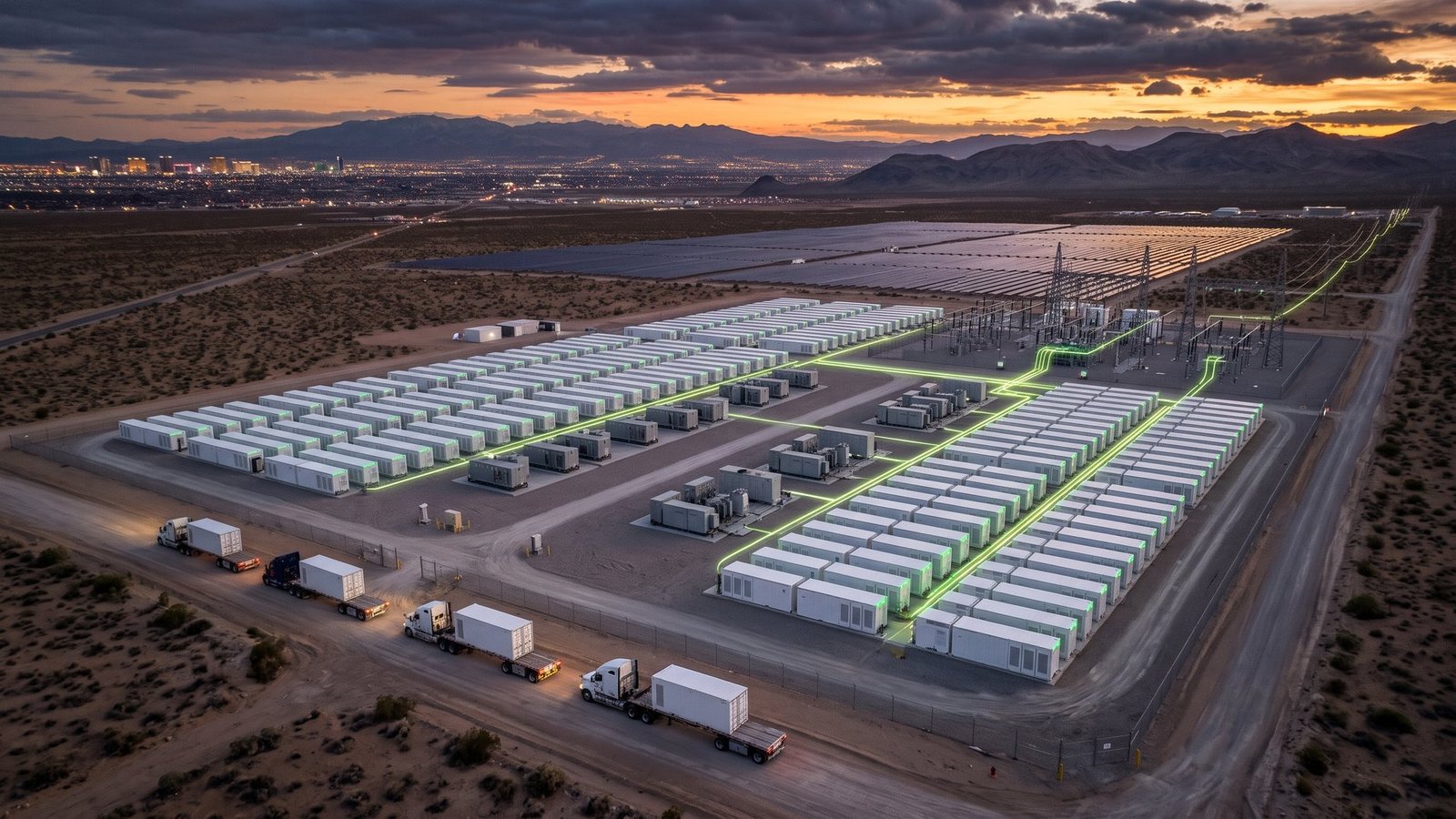
What RE+ 2026 was really about
RE+ moved to the Las Vegas Convention Center this year and brought nearly 40,000 solar, storage and grid professionals to one place. On paper the headlines were about products: 660 W modules, bigger battery cells, all-AC commercial systems, solid-state transformers for AI data centers.
On the storage floor, though, almost every conversation I had came back to one question: where does this battery come from, and can you prove it?
That's not a side issue anymore. For battery energy storage (BESS), sourcing now decides whether a project keeps its tax credit, whether the equipment can legally be installed at all, and whether lenders and tax equity investors will sign off. Three rules drive that: the foreign entity of concern (FEOC) restrictions, the material assistance cost ratio (MACR) that measures compliance, and the Department of Energy rule due December 24 under Executive Order 14421.
Here's what each one means, what I heard in Las Vegas, and what developers and buyers should be doing before the end of the year.
FEOC went from fine print to the headline
A year ago, "FEOC" was a term buried in tax counsel memos. At RE+ 2026, it was printed on booth signage.
NeoVolta marketed its residential and 5 MWh utility-scale systems as FEOC-compliant, with its commercial product expected to qualify starting in March 2027. Moment Energy unveiled Nova, a BESS built from second-life EV batteries that it says is independently verified as FEOC-compliant and certified to UL 9540. Trinasolar emphasized Texas-made, FEOC-compliant modules. Enphase showed its first commercial battery, and SolarEdge launched a Florida-made optimizer designed to meet domestic content and FEOC requirements. Several smaller brands launched "non-FEOC" storage lines aimed at 2027 delivery.
The bigger suppliers are building capacity behind those claims. LG Energy Solution used RE+ to show integrated power systems for AI data centers alongside its BESS line. Its U.S. integrator, LG ES Vertech, has grown from a 1 GWh line in Arizona to a 16 GWh facility in Michigan, and the company is targeting 70 GWh of North American capacity by the end of next year. Its chief product officer called FEOC "a willful signal to the market that as a country, we want to build a domestic supply chain," while adding that developers still need consistent, predictable rules.
That last point captures the mood on the floor. Most people I spoke with weren't arguing against domestic content. They were asking how to prove it, how to price it, and how to avoid being stranded by rules that are still being written.
MACR: the math behind FEOC compliance
The 2025 federal budget law, the One Big Beautiful Bill Act (OBBBA), added "prohibited foreign entity" (PFE) restrictions to the clean electricity tax credits under Sections 48E and 45Y. There are two tests. The first looks at who owns or controls the taxpayer. The second, "material assistance," looks at what's inside the project.
Material assistance is measured with the material assistance cost ratio, or MACR. In plain terms, MACR is the share of a project's direct manufactured-product cost that comes from non-PFE sources. If that share falls below the threshold for the year construction begins, the project generally loses the credit.
For energy storage, the bar is high and rising. IRS Notice 2026-15, released February 12, 2026, confirmed the threshold table: a BESS that begins construction in 2026 needs a MACR of at least 55%, rising to 60% in 2027, 65% in 2028, 70% in 2029 and 75% in 2030 and later. Solar and wind facilities start lower, at 40% in 2026.
That's why battery storage feels the pressure first. Cells are the largest cost item in a BESS, and the global LFP cell supply chain still runs largely through China. A project can use a U.S.-assembled container, a U.S. inverter and U.S. balance of plant, and still fail MACR if the cells come from a prohibited source.
The MACR Bar Keeps Rising for Battery Storage
Minimum material assistance cost ratio (share of direct costs from non-prohibited foreign entities) required to claim the clean electricity tax credits. Source: IRS Notice 2026-15.
Notice 2026-15 also created interim safe harbors, including assigned cost percentages and supplier certifications, so developers don't have to trace every component to the mine. But it left key questions open. Treasury is required to publish full safe-harbor tables by December 31, 2026, and proposed regulations are still to come. As the SEIA and Benchmark storage report released during RE+ week put it, the industry is still waiting on the MACR methodology. In practice, that means supplier certifications and contract terms are doing a lot of the heavy lifting right now.
December 24: the date everyone kept circling
If FEOC and MACR decide whether a project keeps its tax credit, Executive Order 14421 decides whether some equipment can be installed at all.
Signed on August 26, 2026, the order declared a national emergency over foreign-produced bulk-power system equipment. It covers substation transformers, grid-connected inverters, battery energy storage systems, high-voltage breakers, generation turbines and related control systems, software and remote-access capability. It also reaches certain uninterruptible power supply systems, which matters for data centers using batteries for resilience.
The order isn't an immediate blanket ban. It prohibits transactions involving equipment tied to a "Covered Foreign Entity," meaning a country such as China, Russia or Iran, or a company owned, controlled or directed by one, where the transaction poses undue security or reliability risk. The details are left to DOE, which must issue implementing rules by December 24, 2026.
Those rules will answer the questions I heard most at RE+:
- How broad is "Covered Foreign Entity"? Rystad Energy notes that a broad ownership test could capture plants in South Korea or Mexico that use Chinese-controlled components or capital, which would shrink the supply of alternatives.
- What counts as a transaction, and when? The order applies to transactions initiated on or after August 26, 2026, but doesn't define whether that means the purchase order, shipment, delivery or installation. Equipment already installed could face mitigation or even removal.
- Will there be safe harbors and prequalification? DOE's request for information asked about licensing, mitigation agreements and vendor prequalification, but nothing is final yet.
The exposure is real. Rystad found China supplied about 50% of U.S. lithium-ion battery imports by value in the year to June 2026, compared with 3% of transformers and under 1% of high-voltage breakers. In other words, an order framed around grid hardware lands hardest on batteries, and especially on storage serving AI data centers.
Inverters were already hit
Storage buyers are also living with a rule that's already in force. On July 28, 2026, the FCC added foreign-produced, connected power inverters to its Covered List. New foreign-made inverter models, including string, central and hybrid battery inverters, can no longer receive the FCC authorization they need to be imported or sold. Previously authorized models and previously purchased devices are not affected, and a conditional approval pathway exists.
For BESS, that means the power conversion system now carries its own sourcing risk on top of the cells.
Three rules, three different questions
The most common confusion I ran into in Las Vegas was treating these rules as one thing. They aren't. FEOC and MACR are tax rules, enforced through credit eligibility. Executive Order 14421 and the FCC Covered List are security rules, enforced through what can legally be bought, sold and installed. A project can pass one and fail another.
Three Rules Every BESS Buyer Now Has to Track
| Rule | What it controls | What it asks | Key date |
|---|---|---|---|
| FEOC / prohibited foreign entity rules (OBBBA, Sections 48E and 45Y) | Tax credit eligibility | Is the owner, or too much of the equipment, tied to a prohibited foreign entity? | Applies to projects beginning construction in 2026 and later |
| MACR (IRS Notice 2026-15) | How "too much" is measured | Is at least 55% of a 2026-start BESS’s direct manufactured-product cost from non-PFE sources? | Threshold rises 5 points a year; Treasury safe-harbor tables due by Dec. 31, 2026 |
| Executive Order 14421 (DOE) | Whether the equipment can be bought and installed at all | Is the BESS, inverter or control software tied to a Covered Foreign Entity? | DOE rules due Dec. 24, 2026; may reach transactions from Aug. 26, 2026 |
| FCC Covered List (inverters) | Whether new inverter models can be sold | Is it a new, foreign-produced, connected inverter without prior FCC authorization? | In effect since July 28, 2026 |
Demand isn't waiting for the rules
Despite all of this, storage keeps breaking records. The SEIA and Benchmark Mineral Intelligence outlook released during RE+ week found 48.3 GWh of U.S. storage came online in the first nine months of 2026, up 20% from a year earlier, with 40.9 GWh of that utility-scale. Q2 set a quarterly record at 21.5 GWh. Cumulative U.S. installed storage now tops 200 GWh, and the forecast for 2030 rose to 708 GWh.
Data centers are a growing part of the story. Commercial and industrial storage reached 1.8 GWh in Q2 and 1.3 GWh in Q3, driven largely by data center demand. That fits the AI Power Wall theme we've covered all year: storage is how data centers smooth load, ride through grid events and become an energy asset instead of just a load.
What I'd do before December 24
Based on what I heard at RE+, and on two decades of working on the deal side of energy projects, here's the practical checklist for developers, buyers and financiers:
- 1.Map your bill of materials to MACR now. Know where your cells, modules, PCS, BMS and enclosures come from, and get supplier certifications in writing.
- 2.Date your transactions carefully. For Executive Order 14421, document when purchase orders, shipments and deliveries happen relative to August 26, 2026.
- 3.Look past the cell. BMS software, firmware, remote access and maintenance providers are explicitly in scope under the order.
- 4.Write the risk into contracts. Expect sharper supplier representations, indemnities and change-in-law clauses. Lenders and tax equity investors will push "foreign equipment" risk to the developer.
- 5.Model the credit both ways. Run project economics with and without the ITC, and with a sourcing premium, so a rule change doesn't break the deal. Our Utility-Scale BESS Sizing and Behind-the-Meter BESS ROI calculators are a fast place to start.
- 6.Watch December 24 and December 31. DOE's rule and Treasury's safe-harbor tables will settle many of today's open questions.
Conclusion: sourcing is the new spec sheet
For years, BESS buyers compared round-trip efficiency, cycle life, price per kWh and warranty terms. Those still matter. But after RE+ 2026, sourcing sits at the top of the spec sheet. A cheaper system that fails MACR or falls under Executive Order 14421 isn't cheaper at all.
The good news is that the industry is responding. U.S. cell, module and inverter capacity is growing, major suppliers are localizing, and FEOC-compliant products are moving from press releases to delivery schedules. The challenge is timing. The rules are tightening every year, while much of the domestic supply chain is still ramping.
The developers who come out ahead will be the ones who treat compliance as part of procurement from day one, not a box to check at financial close.
Based on conversations at RE+ 2026 in Las Vegas (November 16–19, 2026), IRS Notice 2026-15, Executive Order 14421, the FCC Covered List action of July 28, 2026, the SEIA–Benchmark U.S. Energy Storage Market Outlook (Q4 2026), Rystad Energy, Bracewell, Troutman Pepper Locke, Foley, Energy-Storage.news and exhibitor announcements. This article is general information, not legal or tax advice.
Chris Kalowes
Founder, WattThe?!
Energy intelligence. Simplified.