
Why this deal matters
AI is forcing the technology industry to face something the energy sector has known for decades. Electricity infrastructure can't scale at the speed of computing infrastructure. GPUs can be ordered and servers installed in months. Hundreds of megawatts of generation, transmission and substations take years. As AI campuses grow from tens of megawatts to hundreds, and in some cases gigawatts, access to power is becoming the constraint that decides where, when and how AI gets built. We've called this the AI Power Wall.
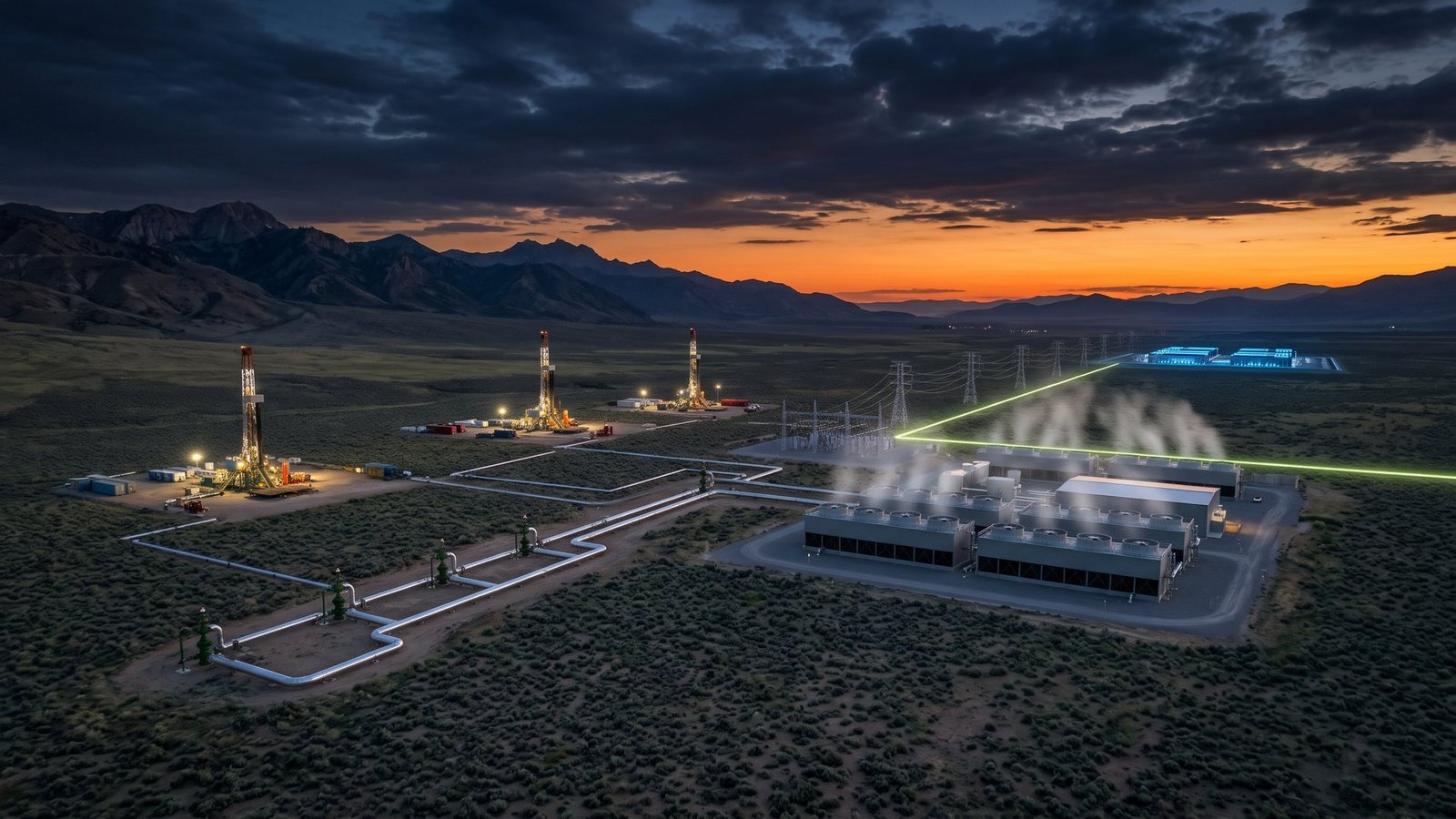
Google's agreement with Fervo Energy is one of the clearest examples of how hyperscalers are responding. On September 1, 2026, Fervo and Google signed a 396 MW power purchase agreement for electricity from Fervo's Cape Station enhanced geothermal project in Beaver County, Utah. The contract runs 15 years. Google also holds an option to add roughly 600 MW more by June 2030, which would bring the total close to 1 GW. Fervo calls it the largest enhanced geothermal PPA on record.
The power is meant to anchor a potential Google Utah data center, though that plan still depends on engineering, state and local approvals, and commercial terms. That sequencing is the real story. Google isn't just buying clean energy credits for an existing data center. It's securing firm power first and then planning the data center around it.
Since we first wrote: Cape Station is producing power
When we published this article in early September, Cape Station was still under construction. That has changed quickly.
On September 24, Fervo announced first power from Cape Station, making it the first utility-scale enhanced geothermal development in the world to reach that milestone. On September 30, the first 33 MW GeoBlock reached commercial operation, ahead of its contractual date. CEO Tim Latimer said no team had ever built a project like this anywhere in the world, "and we did it ahead of schedule."
According to Fervo's third-quarter results, released November 9, the second GeoBlock is already synced to the grid and delivering test energy. The third is mechanically complete and in commissioning. Both are expected to reach commercial operation by January 1, 2027, completing the roughly 100 MW Phase I. Drilling for the 400 MW Google phase, which Fervo calls Cape Google 400, is about 18% complete and aimed at 2028.
The Google deal also transformed Fervo's business. Contracted capacity jumped from 658 MW at the end of the second quarter to 1,054 MW, and contracted revenue rose from about $7.2 billion to about $11.9 billion. Other buyers include Southern California Edison, Shell Energy and Clean Power Alliance.
What enhanced geothermal actually is
Traditional geothermal plants depend on rare natural reservoirs of hot water and steam near the surface. That's why geothermal has stayed a small, regional resource, mostly in places like California's Geysers.
Enhanced geothermal systems (EGS) create the reservoir instead of finding it. Using drilling techniques borrowed from the oil and gas industry, Fervo drills wells about 10,000 feet deep, then extends them horizontally about 7,500 feet through hot rock, according to Fortune. Water is pumped down, heated to more than 400 degrees Fahrenheit as it flows through fractures in the rock, and brought back up to drive turbines. The cooled water is then reinjected to be heated again.
The result is clean power that runs around the clock, regardless of weather or time of day. For AI data centers that need steady power 24/7, that's exactly the profile they want. Wind and solar are cheaper per megawatt-hour, but they need battery storage or backup to deliver firm capacity.
From a small pilot to a working power plant
The speed of the Google-Fervo relationship stands out. The companies signed a corporate agreement in 2021. Fervo's Project Red pilot in Nevada came online in 2023 at 3.5 MW, supplying the grid that serves Google's Nevada operations. In June 2024, Google, NV Energy and Fervo signed a 115 MW deal under NV Energy's Clean Transition Tariff, a rate design that lets Google bring new clean power onto the grid while shielding other customers from the cost. That's a model worth watching as states debate who pays for AI's power. Google then invested in Fervo's $462 million Series E round in December 2025, and Fervo went public in May 2026.
| Date | Milestone | Size |
|---|---|---|
| 2021 | Google and Fervo sign a corporate agreement to develop next-generation geothermal | — |
| 2023 | Project Red pilot in Nevada comes online, supplying the grid that serves Google | 3.5 MW |
| June 2024 | NV Energy Clean Transition Tariff PPA with Google | 115 MW |
| Dec 2025 | Google joins Fervo's Series E round | $462M round |
| May 2026 | Fervo goes public | IPO |
| Sept 1, 2026 | Google signs 15-year Cape Station PPA, with option for ~600 MW more by June 2030 | 396 MW (up to ~1 GW) |
| Sept 30, 2026 | Cape Station GeoBlock 1 reaches commercial operation | 33 MW |
| By Jan 1, 2027 | GeoBlocks 2 and 3 complete Phase I (expected) | ~100 MW total |
| 2028 | Cape Google 400 (GeoBlocks 4–11) expected online | 400 MW |
Fervo's approach is built on standardization. It builds power plants in repeatable units called GeoBlocks and groups them into larger GeoClusters. Phase I at Cape Station uses three 33 MW GeoBlocks. The Google phase steps up to eight 50 MW GeoBlocks. Fervo says the first GeoBlock took 23 months to build and it aims to cut future ones to about 18 months. As one Fervo executive put it, every GeoBlock makes the next one "faster and more predictable."
That matters because hyperscalers don't need one successful geothermal plant. They need a power source they can deploy again and again across a large portfolio of AI factories. Cape Station is the test of whether enhanced geothermal can become a repeatable, utility-scale product.
The cost curve is real, not just a talking point
Fervo's own numbers show how quickly costs are moving. In its third-quarter results, the company put the expected all-in cost of Phase I at about $7,000 per kilowatt. Its target for the 400 MW Google phase is $5,500/kW, and its long-term goal is $3,000/kW as drilling and construction become more standardized.
For context, industry estimates put enhanced geothermal capital costs around $28,000/kW in 2021. Falling from there to $7,000 in about five years is a major shift. If the $3,000 target is reached, geothermal would compete directly with new gas plants and nuclear for firm, clean capacity. You can test how capital cost, capacity factor and financing affect the price of power with our Geothermal LCOE Calculator and the broader LCOE Calculator.
Enhanced Geothermal’s Falling Cost Curve ($/kW)
All-in capital cost per kilowatt. Sources: Fervo Energy Q3 2026 results; industry estimates.
Generation alone doesn't solve the data center power problem
As exciting as nearly 1 GW of geothermal is, generating electricity and delivering it are two different challenges. A developer can sign a contract with a 500 MW power plant and still be unable to energize a 500 MW data center if the transmission lines, substations and interconnection capacity don't exist.
Analysts reviewing the deal flagged interconnection bottlenecks, capital intensity, first-of-a-kind execution and competition from other technologies as real risks. That points to a distinction every data center energy plan should start with: nameplate capacity isn't the same as deliverable capacity.
For a data center developer, the real equation is generation plus transmission, interconnection, substations, storage, reliability, commercial structure and time-to-power. A weakness anywhere in that chain can delay the whole project. Start by sizing how much power a campus needs, then work backward through every link.
Enhanced geothermal still has something to prove
Cape Station's first power is a major milestone, but one 33 MW GeoBlock is not a gigawatt. Scaling to hundreds of megawatts brings engineering, financing, construction and interconnection risk. The energy industry has seen plenty of technologies succeed at demonstration scale and then struggle with the economics of mass deployment.
Investors have noticed both the promise and the risk. Fortune reported that Fervo's market value climbed above $10 billion after its IPO before falling to about $5 billion. The key questions now are whether drilling can get faster and more predictable, whether GeoBlocks really reduce construction risk, whether costs keep falling, and whether lenders will finance projects without a big technology-risk premium. Cape Station is the real-world test.
Geothermal doesn't need to replace other technologies to matter. It needs to reliably and economically supply a share of the firm power AI requires, alongside gas, battery storage, transmission and eventually small modular reactors.
The bigger story: energy-first development
It would be easy to read this as just another clean energy deal. That misses the point. The bigger story is that energy development and digital infrastructure development are merging and starting to run on the same planning timeline.
That's creating a new development model: energy-first. Instead of picking a site and then figuring out how to power it, developers are finding places with scalable, reliable energy and then deciding whether a data center can be built around it. As we asked in Is compute the new oil?, the advantage goes to whoever controls the energy. Done well, these projects can also make the data center an energy asset for the region rather than a burden.
Conclusion: firm megawatts, delivered on time
Google's agreement with Fervo matters because of the numbers: 396 MW now, an option for about 600 MW more, and a potential total near 1 GW of enhanced geothermal power. It matters even more now that Cape Station has proven it can deliver.
The next generation of AI infrastructure won't be defined only by who has the best GPUs or the largest models. It will be defined by who can secure the generation, transmission, substations, storage and utility infrastructure to keep those systems running, and who can bring it online fast enough. The AI race is becoming an energy infrastructure race. The most valuable commodity in the next phase may simply be firm megawatts delivered on time.
Sources: Fervo Energy and Google announcements (September 2026); Fervo Energy third-quarter 2026 results; Utility Dive; The Salt Lake Tribune; ESG Today; Yahoo Finance; Fortune; Power Engineering; ThinkGeoEnergy.
Chris Kalowes
Founder, WattThe?!
Energy intelligence. Simplified.